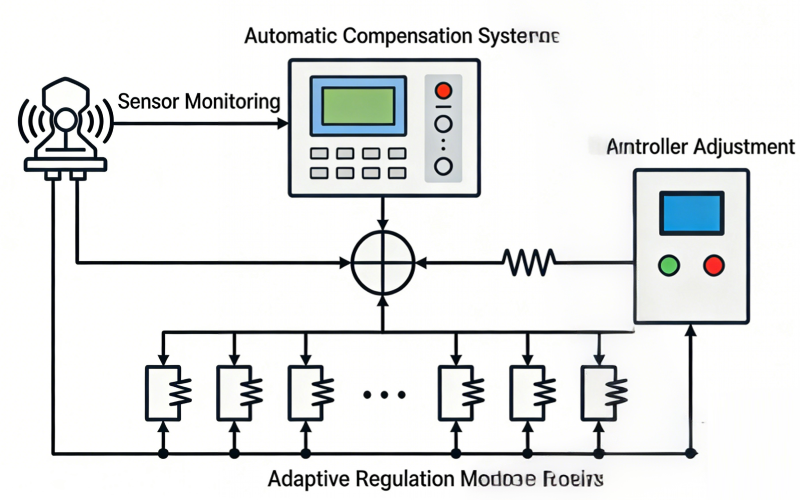
Role in Reactive Power Control
Compensation capacitors are dedicated to supplying reactive power locally in AC systems. Their primary objective is to offset inductive reactive demand, thereby improving power factor and stabilizing voltage levels across distribution networks.
Under IEC system philosophy, Reactive Power Compensation is not merely an economic measure but a technical requirement for maintaining system efficiency and operational margins.
Reactive Power Behavior in Industrial Loads
Industrial loads such as induction motors, transformers, and magnetic ballasts inherently consume reactive power. Without compensation, this reactive demand increases current flow, resulting in higher losses and reduced usable capacity of electrical infrastructure.
Compensation Capacitors inject capacitive reactive power, reducing the net reactive exchange between the load and the upstream network.
Fixed vs Automatic Compensation
Compensation capacitors may be installed as fixed units or as part of automatically controlled banks. Fixed compensation is suitable for steady loads, while automatic systems adjust capacitor steps dynamically to match varying reactive demand.
Automatic compensation improves system adaptability and reduces the risk of overcompensation during low-load conditions.
Integration with Protection and Control
Proper coordination with protection devices is essential. Compensation capacitors must be protected against overcurrent, overvoltage, and excessive temperature. IEC-compliant designs incorporate monitoring and staged switching strategies to enhance reliability.
FAQ
Do compensation capacitors affect active power?
No. They influence current flow and losses but do not change active power consumption.
Is centralized compensation always preferable?
Not necessarily. Distributed compensation can reduce feeder losses more effectively in some systems.

 English
 Español
 Portugues
 Pусский
 Français
 Deutsch
 日本語
日本語
 한국어
한국어
 العربية
 Italiano
 Nederlands
 Svenska
 Polski
 Türk dili
 हिन्दी
 Melayu
 dansk
dansk
 Magyar
 қазақ
қазақ
 বাংলা
বাংলা
 עִברִית
 čeština
 українська
 беларускі
 Filipino
 Suomalainen
 اردو
اردو
 հայերեն
 български
 Hrvatski
 galego
 नेपाल
नेपाल
 euskara
 Shqipëria
 Malagasy
 Башҡорт
 Türkmenler
 Ilocano
 Нохчийн



 ada apa
 Telepon
Komentar
(0)